We throw around the word 'universe' as if we can picture it. We can't — not really. The human brain evolved to judge distances you could walk. To grasp the scale of the cosmos, you have to climb a ladder of numbers where every rung is almost unimaginably higher than the last.
Start with our own backyard
Light is the fastest thing there is, crossing about 300,000 kilometres every second. It reaches us from the Moon in just over a second, and from the Sun in about eight minutes. Already that's strange — you never see the Sun as it is now, only as it was eight minutes ago.
Leaving the neighborhood
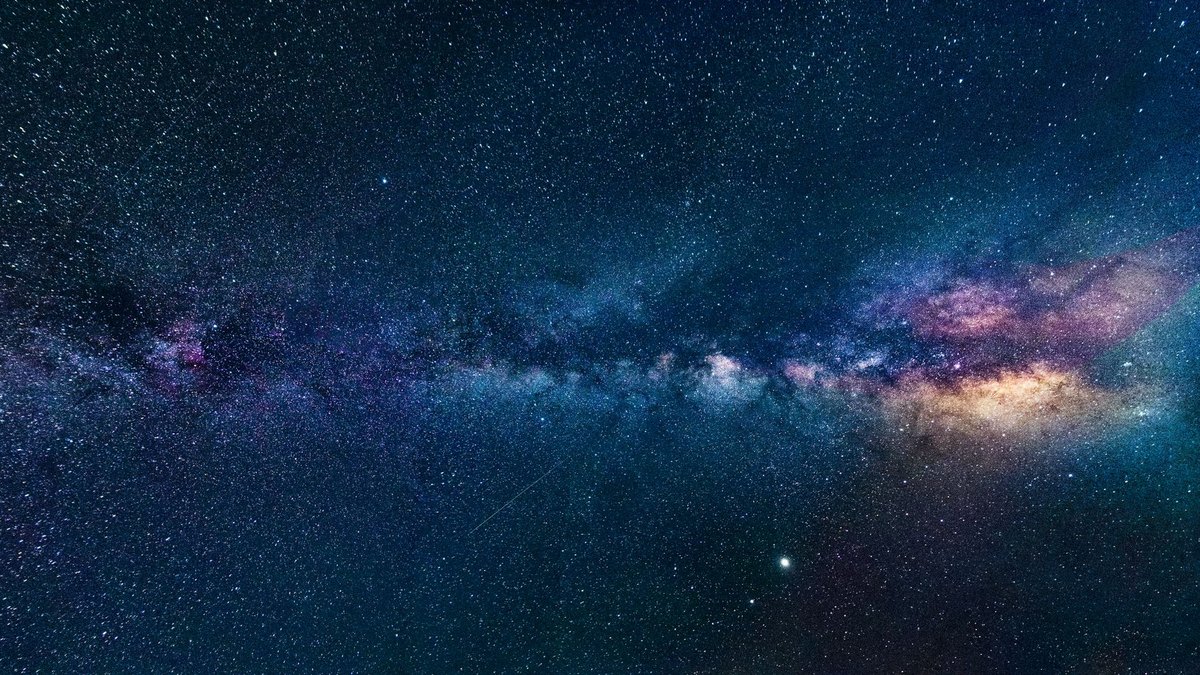
The nearest star beyond the Sun is over four light-years away, meaning its light takes more than four years to arrive. Our galaxy, the Milky Way, is a swirl of a few hundred billion stars stretching about 100,000 light-years across. If the entire Milky Way were shrunk to the size of a country, our Sun would be far smaller than a single grain of dust.
Galaxies beyond counting
And the Milky Way is just one galaxy. Modern estimates suggest the observable universe contains hundreds of billions, perhaps trillions, of galaxies — each with its own hundreds of billions of stars. The number of stars in the sky rivals or exceeds the number of grains of sand on every beach on Earth.
The edge we can see
The 'observable universe' — the part whose light has had time to reach us since the beginning — is a sphere roughly 93 billion light-years across. But that's only what we can see. The universe as a whole may be far larger, possibly infinite. We are looking out from one small planet at a bubble of light, with no way to know how much lies beyond its edge.
It's easy to find this frightening — proof of how small we are. But there's another way to hold it. Every atom in your body was forged inside a star. The universe is vast beyond comprehension, and somehow a corner of it became curious enough to try to measure itself. That corner is you.

Be the first to share a thought.